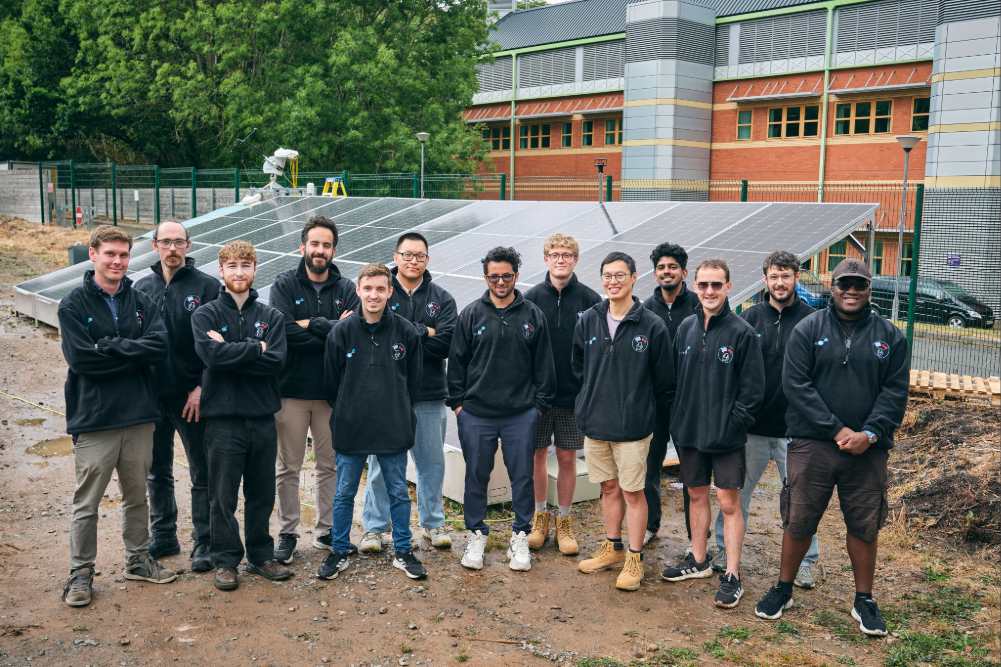
Researchers have developed an innovative system that turns solar energy into green hydrogen, after taking on a real-world Design and Build Challenge set by East Midlands Freeport.
The project brought together first-year doctoral researchers from EnerHy’s second cohort to design and build a solar farm measurement system alongside a thermally integrated photovoltaic-electrolyser – an approach designed to improve the efficiency of green hydrogen production.
It marks the culmination of the 2026 EnerHy Research Conference and demonstrates what can happen when ambitious research, industry-led challenge-setting and the right innovation infrastructure come together.
The challenge from East Midlands Freeport was an opportunity to turn its commitment to green growth, skills and innovation into a practical brief for the next generation of clean-energy engineers and researchers.
A challenge with a real-world purpose
After developing their ideas remotely, the team of researchers from Loughborough University, Cranfield University and the University of Strathclyde came together at Loughborough University for an intensive three-week programme, turning their concepts into a real-world solution.
The result combined a solar farm measurement system with a thermally integrated photovoltaic-electrolyser. By recovering heat generated by solar panels and using it in the electrolysis process, the system explored a more efficient approach to producing green hydrogen.
Learning by building
The challenge gave researchers the chance to develop practical skills outside their own specialisms and work together to solve a complex energy problem.
From soldering and fabrication to electronics, instrumentation and system integration, the team combined their expertise to deliver a working solution to a fixed deadline.
Dr Tom Betts, Reader in Applied Photovoltaics at Loughborough University, said: “EnerHy gives students the best of both worlds: independent research and hands-on, team-based challenges. This project shows how effectively they can work under pressure across disciplines, developing the skills needed to lead the next generation of clean energy innovation.”
From idea to demonstration
The completed systems were showcased during the launch of the East Midlands Freeport-funded Zero Carbon Innovation Centre at Loughborough University, giving visitors, partners and stakeholders the chance to see the researchers’ work in action.
The centre is part of East Midlands Freeport’s wider commitment to supporting research, innovation and skills that can help accelerate the transition to a lower-carbon economy. By setting the Design and Build Challenge and supporting the development of the centre, the Freeport has helped create an environment where researchers can test ideas, build new capabilities and respond to real-world industrial challenges.
Katie Greenhalgh, Head of Green Growth and Inclusion at East Midlands Freeport and a member of the EnerHy Independent Advisory Board, said: “When you give students the opportunity to tackle complex industry challenges and access to facilities like those we have at the Zero Carbon Innovation Centre, it just goes to show what they can achieve.”
Building the capabilities for net zero
The project is a powerful example of how the East Midlands can connect its research strengths with the practical needs of industry and the energy transition.
The Freeport’s challenge provided the doctoral researchers with valuable experience of designing, building and delivering a complex system as a team.
It also demonstrates the region’s potential of combining world-class research, specialist facilities and real-world challenge-setting to help develop both the technologies and talent needed for a net-zero future.