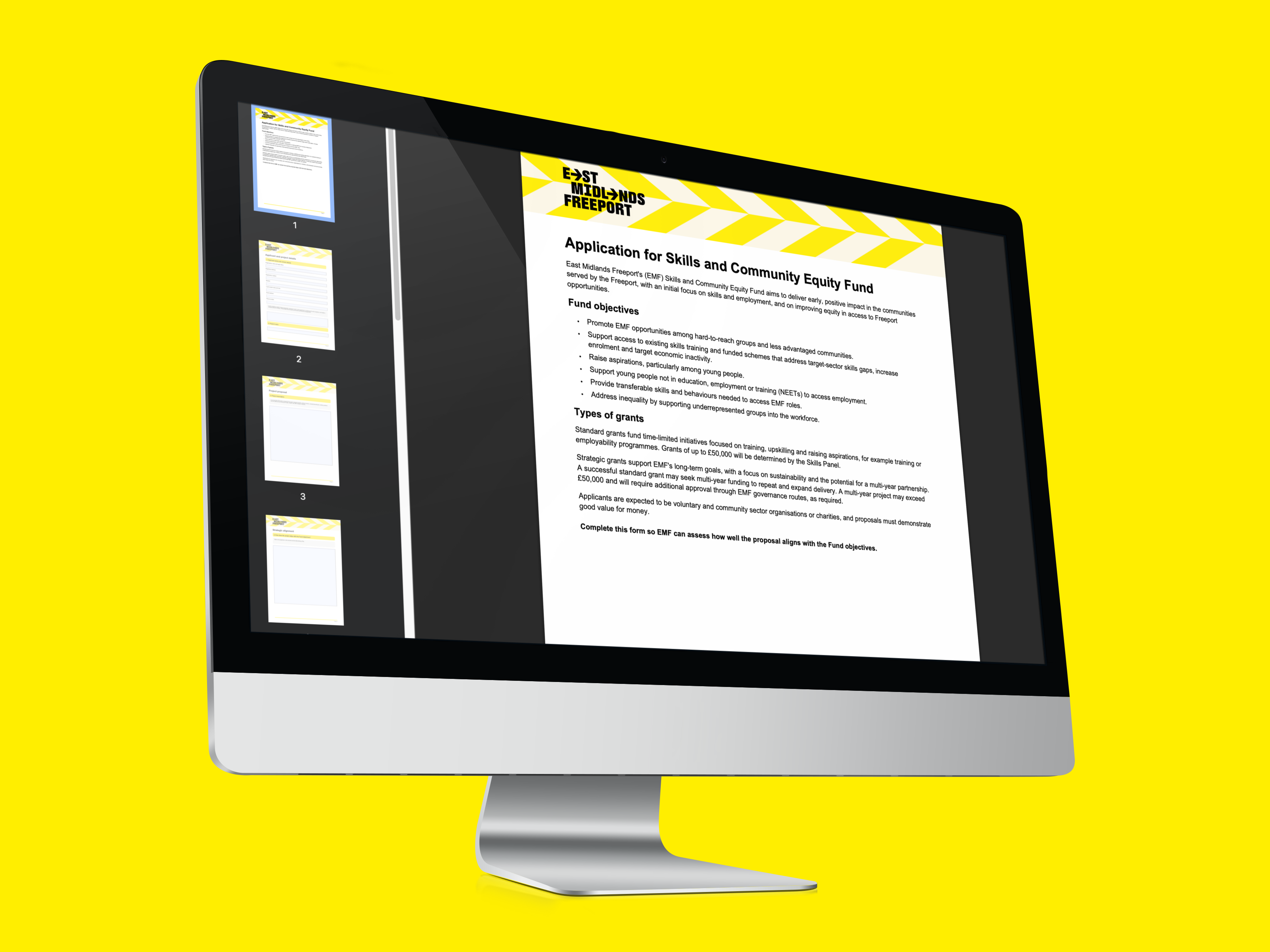
This guide is designed to help applicants complete the Skills and Community Equity Fund application form clearly and confidently. It explains what information to include in each section, highlights the key points assessors will look for, and identifies common mistakes to avoid.
Applicants should use this guide when completing the application form to make sure their proposal is eligible, well evidenced, realistic and aligned with the Fund’s aims to improve skills, employment, equity and access to East Midlands Freeport opportunities.
Fund overview and key dates
East Midlands Freeport (EMF) is inviting organisations to apply to the next round of its Skills and Community Equity Fund. The Fund is intended to deliver early, positive impact in communities served by East Midlands Freeport. It will prioritise projects that strengthen skills and employability, raise aspiration, remove barriers to opportunity and create clearer routes into training and work.
Applications will open on 9 September 2026 and close at 5pm on 6 October 2026. Complete the application form and submit it to info@emfreeport.com by the deadline. Applicants requiring support can find more information on our website.
A step-by-step guide
Before you start:
Check that your project fits the criteria, as set out on the application form, especially around skills, employment, access to Freeport opportunities, aspiration-raising, support for people not in education, employment or training (NEET), and underrepresented groups. The people, communities or employers benefiting from the project should be within the Freeport area, those based outside may apply where they can clearly demonstrate that the funded activity and intended beneficiaries are within the eligible area.
Projects should help local people benefit from Freeport investment by providing relevant skills or training connected to Freeport careers, linking people with existing training and employment support, or building the confidence, skills and behaviours needed to progress.
We particularly welcome proposals supporting young people, underrepresented groups, people furthest from the labour market and communities facing disadvantage. Activity may include aspiration-raising, employability, technical or transferable skills, and practical support to address barriers such as transport, health, confidence or digital exclusion. Projects may also support community engagement or improvements in communities affected by Freeport development.
Check your organisation is eligible
The Fund is intended for constituted voluntary and community-sector organisations or charities that can enter into a grant agreement and manage public funding responsibly. Partnership applications are welcome, but one organisation must act as the accountable lead. Applicants may be asked to provide relevant policies, insurance, bank details, accounts and other due-diligence information. The Fund cannot support individuals, usual organisational running costs, retrospective costs, political or religious activity, statutory duties, or projects that replace or duplicate existing provision.
Choose the right grant type
Decide whether you are applying for:
-
- Standard grant: time-limited activity, usually up to £50,000.
- Strategic grant: longer-term or multi-year activity, potentially over £50,000, subject to further approval.
Micro grants are not available in this funding round but will be introduced in the new year.
Complete applicant details
Add your organisation name, address, and company number, website, lead contact, email address and phone number.
Add your project name
Use a clear and simple title that describes the activity.
Describe your project
In no more than 500 words, explain:
- what the project will do
- who it will support
- where it will take place
- what the funding will deliver
- why the project is needed and what would happen if the project was not funded
Evidence the need
Describe the problem, gap or opportunity the project addresses. Use relevant local evidence where possible, such as labour-market data, employer intelligence, referral information, community feedback or learning from previous delivery. Explain what provision already exists and how intended beneficiaries or employers have shaped the proposal.
Explain how the project meets the Fund objectives
Link your project directly to the objectives listed in the form, such as supporting hard-to-reach groups, improving access to training, raising aspirations, addressing skills gaps, or helping people into employment.
Proposals must align with East Midlands Freeport’s Skills Delivery Plan.
Priority will be given to strong proposals that take provision into communities, reach people who may not otherwise engage with existing opportunities, or support sectors where skills demand is expected to grow, including engineering, logistics, clean energy, digital and advanced manufacturing.
Applicants should focus on making the strongest case for their own project rather than attempting to cover every priority.
Set out the project programme
Include:
- proposed start date, which should be after 10 November 2026 and once a grant agreement is in place
- completion date
- key milestones
- when main activities will take place
- realistic timescales that allow for mobilisation, recruitment, procurement, delivery, reporting and contingencies.
Confirm the total project cost
State the full cost of delivering the project, including all funding sources.
State how much funding you are requesting from EMF
Clearly show the amount requested from the Skills and Community Equity Fund and explain why it is necessary and proportionate. Standard and Strategic grants will normally be paid in arrears through agreed stage payments. Payment will be made only after the relevant stage has been completed and satisfactory claim, monitoring and supporting evidence has been approved. Applicants should consider whether they have sufficient cash flow to manage the period between expenditure and reimbursement.
Include any match funding
If other funding is being used, explain:
- where it is coming from
- how much it is
- whether it is secured or still awaiting approval
Provide a cost breakdown
Explain what the money will be spent on and how each cost has been calculated. Include items such as additional project staffing, venue hire, equipment, materials, training delivery, proportionate marketing, evaluation or participant support. Costs must be reasonable, necessary and directly attributable to the project. Explain any overheads, management costs, contingency or apportioned costs. Do not include recoverable VAT.
Explain any non-financial support needed
Say whether you need support from EMF or partners, such as introductions, employer engagement, venues, volunteers, promotion, data, or advice. Explain what would happen if this support was not available.
Describe outputs, outcomes and impact
Be as specific and measurable as possible. For example, an output could be 40 people completing six training sessions; an outcome could be 30 people gaining a qualification and 15 progressing into work, education or further training; and the impact could be improved access to local employment for an underserved community. Include a baseline where relevant, a target, timescale, evidence source and reporting method.
- number of people supported
- number of sessions delivered
- qualifications or training completed
- people moving into work, education or further training
- communities or groups reached
Explain how you will deliver successfully
Summarise your experience, track record, staff capacity, partnerships and delivery approach. The assessor will want to be confident that you have the capability to successfully deliver your proposal.
The pilot phase introduced young people to engineering, strengthened science, technology, engineering and mathematics learning in schools, and provided accredited logistics training with wraparound support for people furthest from work. Applicants should consider what can be learned from these approaches, including the value of engaging people early, taking activity into communities, working with trusted partners and combining technical training with support to overcome practical barriers.
Identify key risks
List the main risks that could affect delivery, costs, reputation or impact, such as recruitment, delays, staffing, partner dependency, venue availability, participant engagement, safeguarding, data protection, match funding, cash flow or rising costs. For each risk, identify its likelihood and impact, the mitigation, the responsible owner and any contingency.
Review monitoring and claims requirements
These can be accessed in the Claims and Project Monitoring Guide to project claims and monitoring process. Please review and ask any questions in advance of the application. These will be part of the requirements of your grant.
Additional requirements
Check procurement requirements
If you intend to buy goods, works or services worth £10,000 or more, excluding VAT, you should seek at least three competitive written quotations unless EMF has approved an alternative approach. Keep a clear audit trail of quotations, evaluation, approval and the reasons for the decision. Where three quotations cannot reasonably be obtained, explain why and retain supporting evidence. Public bodies and organisations subject to procurement legislation must also follow their own legal and organisational requirements.
Check subsidy-control requirements
EMF will determine the appropriate subsidy-control route after reviewing the application and the applicant’s declarations. An award may be made as Minimal Financial Assistance (MFA) under the Subsidy Control Act 2022. If this route applies, applicants will need to confirm that the award will not cause the relevant enterprise to exceed the £315,000 limit during the elapsed part of the current financial year and the two preceding financial years. Disclose relevant previous assistance and raise any questions early.
Understand how applications will be assessed
Applications will first be checked for eligibility and then assessed on alignment with the Fund objectives, evidence of need, additionality, reach into priority groups or communities, quality and clarity of delivery, measurable outcomes, organisational capability, value for money, affordability, risk management and monitoring arrangements. Funding is competitive and meeting the eligibility requirements does not guarantee an award. EMF may seek clarification, complete due diligence, propose changes to the scope or budget, offer less funding than requested or place conditions on an award.
Applications will be assessed on their individual quality and alignment with the Fund’s objectives. East Midlands Freeport will then select a balanced portfolio across project sizes, locations, audiences and themes, enabling support for a mix of grassroots community activity and larger skills and employability programmes.
The highest-scoring projects will be funded in this round. Other fundable applications may be considered in a further round, subject to demand, available funding and approval.
Check wider compliance requirements
Consider safeguarding, equality and accessibility, data protection and participant consent, health and safety, insurance, conflicts of interest, and communications or branding requirements. Applicants may be asked to provide relevant policies or evidence during due diligence and monitoring.
Meet-the-funder support
Applicants are encouraged to attend a meet-the-funder session to discuss the Fund and ask questions before submitting:
- Wednesday 16 September 2026, 1.30pm to 4.30pm, Dryden Centre, Nottingham, NG1 4FQ
- Friday 18 September 2026, 9.30am to 12.30pm, Coalville C.A.N. (CAN HQ), Memorial Square, Coalville, LE67 3TU
- Friday 18 September 2026, 2.00pm to 4.30pm, Medical Technologies Innovation Facility, Clifton Lane, Clifton, Nottingham, NG11 8NS
Review before submitting
Make sure every section is complete, figures are consistent, the project clearly aligns with the Fund, and your answers are concise, specific and evidence-based.
Key points to remember
- The Fund supports projects benefiting people, communities or employers within the East Midlands Freeport travel-to-work area which improve skills, employment, equity and access to East Midlands Freeport opportunities.
- Priority will be given to projects supporting hard-to-reach groups, less advantaged communities, NEETs, young people and underrepresented groups.
- Projects should respond to evidenced skills gaps. Priority areas may include green skills, digital, engineering, leadership or project management where these are relevant to the project and local need.
- Standard grants are generally for time-limited activity up to £50,000.
- Strategic grants may support longer-term or multi-year activity and may exceed £50,000 but require additional approval.
- Applications should be clear, concise, evidence-based and measurable.
- Budgets should be realistic, transparent and exclude ineligible costs.
- Applicants should explain what will be delivered, who will benefit, how success will be measured and how risks will be managed.
- Monitoring will be required, and payments will be made in arrears after evidence of spend is provided.
Common mistakes to avoid
Does not represent good value for money
Make sure the application shows how costs have been calculated, why they are reasonable and what scale and quality of benefit will be achieved from the funding requested.
Requesting funding for existing activity
Awards will only be made where the application demonstrates additional activity or benefit in the EMF area. Explain what will be new, expanded or improved because of the grant.
Providing an unclear project description
Ensure there is consistency across the answers and clarity on exactly what is being delivered.
Not including measurable outputs or outcomes
Include numbers where possible, such as participants supported, sessions delivered, qualifications gained, or people moving into work or training.
Confusing outputs, outcomes and impact
Outputs are activities delivered; outcomes are changes achieved; impact is the wider benefit for communities or employers.
Not considering subsidy-control requirements
Applicants should disclose relevant previous assistance and provide the information EMF needs to determine the appropriate subsidy-control route. If Minimal Financial Assistance applies, they must remain within the £315,000 limit for the relevant period.
Not explaining delivery capability
Include relevant track record, staff experience, partnerships and practical arrangements.
Final submission checklist
Before submitting:
- Check that every question is answered
- The applicant and project are eligible
- The activity benefits the Freeport travel-to-work area
- The need and additionality are evidenced
- Dates and milestones are realistic
- Outputs, outcomes and impact are measurable
- The budget reconciles throughout
- Match funding is accurately described
- Cash flow, procurement and subsidy control have been considered
- Relevant safeguarding, equality, data protection, health and safety, insurance and conflict-of-interest arrangements are in place
- Required documents and approvals are included
- Contact details are correct
- The application has been proofread and submitted by the deadline.